Quantum cryptography is a technology that will replace every cryptography system that we know. It is a growing domain with new techniques and new ideas that appear every day. In this article we will discover how basic quantum cryptography works with BB84 and what is the future of cryptography.
I. What is Quantum cryptography
Quantum cryptography uses quantum physics to establish cryptography protocols like BB84, E91, and B92. The idea of quantum cryptography was introduced by Stephen Wiesner in the early 1970s. His paper named Conjugate Coding was rejected by the IEEE but finally got published in 1983 in SIGACT News. In this paper he demonstrated how to encode photons. It was not until Charles H. Bennett and Gilles Brassard met that they discovered how to use Stephen's discovery. Then they worked upon his work and made the first quantum key distribution system now known as BB84.
II. Quantum mechanics
We need to know basic concepts of quantum mechanics to understand how quantum cryptography works.
1. The uncertainty principle
Also known as Heisenberg's indeterminacy principle, it is a fundamental concept in quantum mechanics. It states that > "there is a limit to the precision with which certain pairs of physical properties, such as position and momentum, can be simultaneously known"
That means that the more we measure the position of a particle, the less we will be able to know its speed. This is linked to the Fourier transform.
2. Quantum superposition
Quantum superposition is another fundamental principle of quantum mechanics. Basically it says that a system can exist in a superposition of states until we measure it, like the Schrödinger cat if we put a cat in a box with a mortal radioactive trap. According to quantum physics, if we don't open the box we can't know if the cat is dead or alive, so he is dead and alive at the same time.
III. How basic quantum cryptography works with BB84
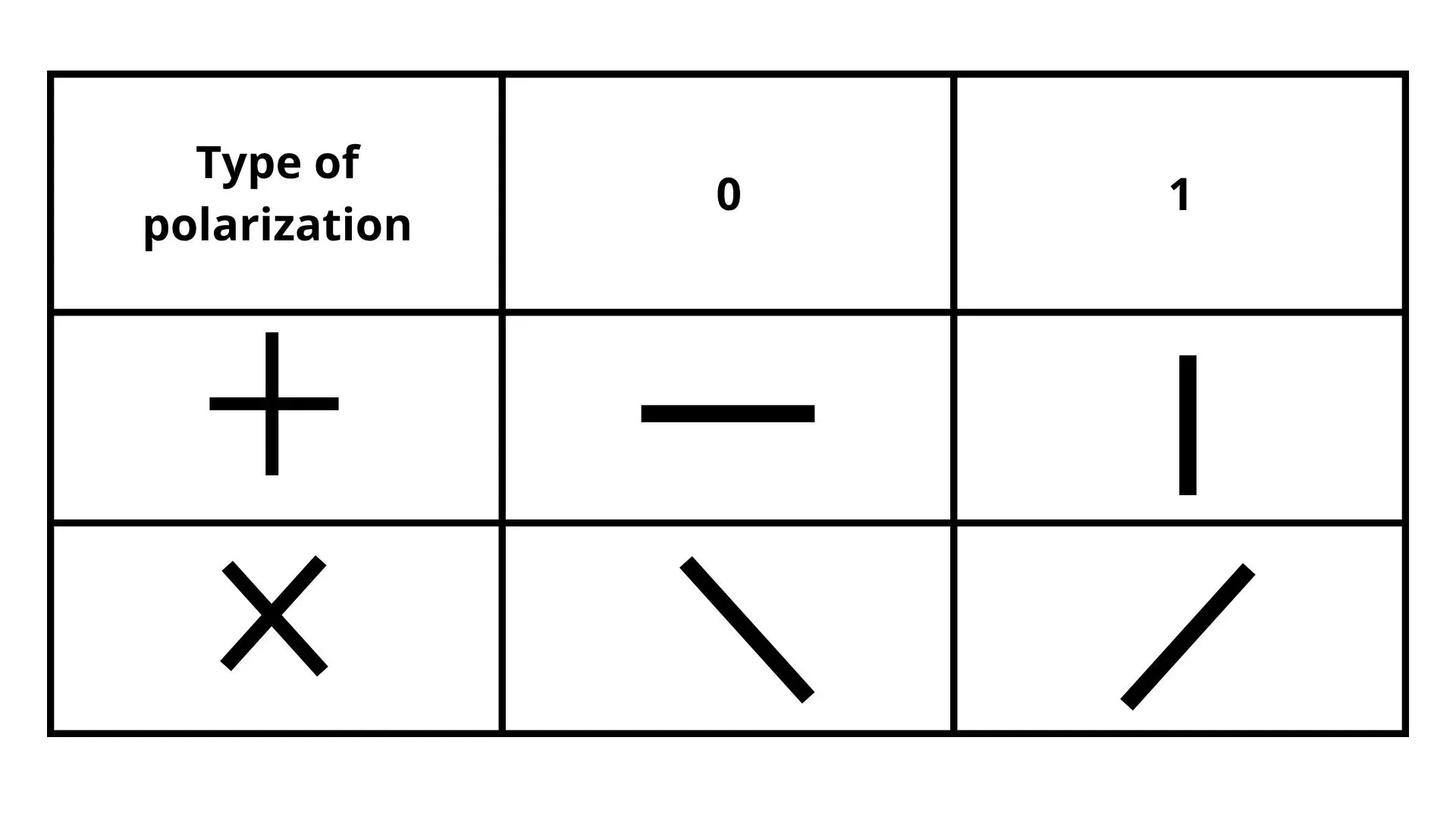
Firstly, we need to create a key. For that, we will use photons. The sender will send a series of polarized photons.
- rectilinear: horizontal 0∘ or vertical 90∘.
- diagonal: 45∘ or 135∘.
The position of the photon will be a binary is assigned with bianry
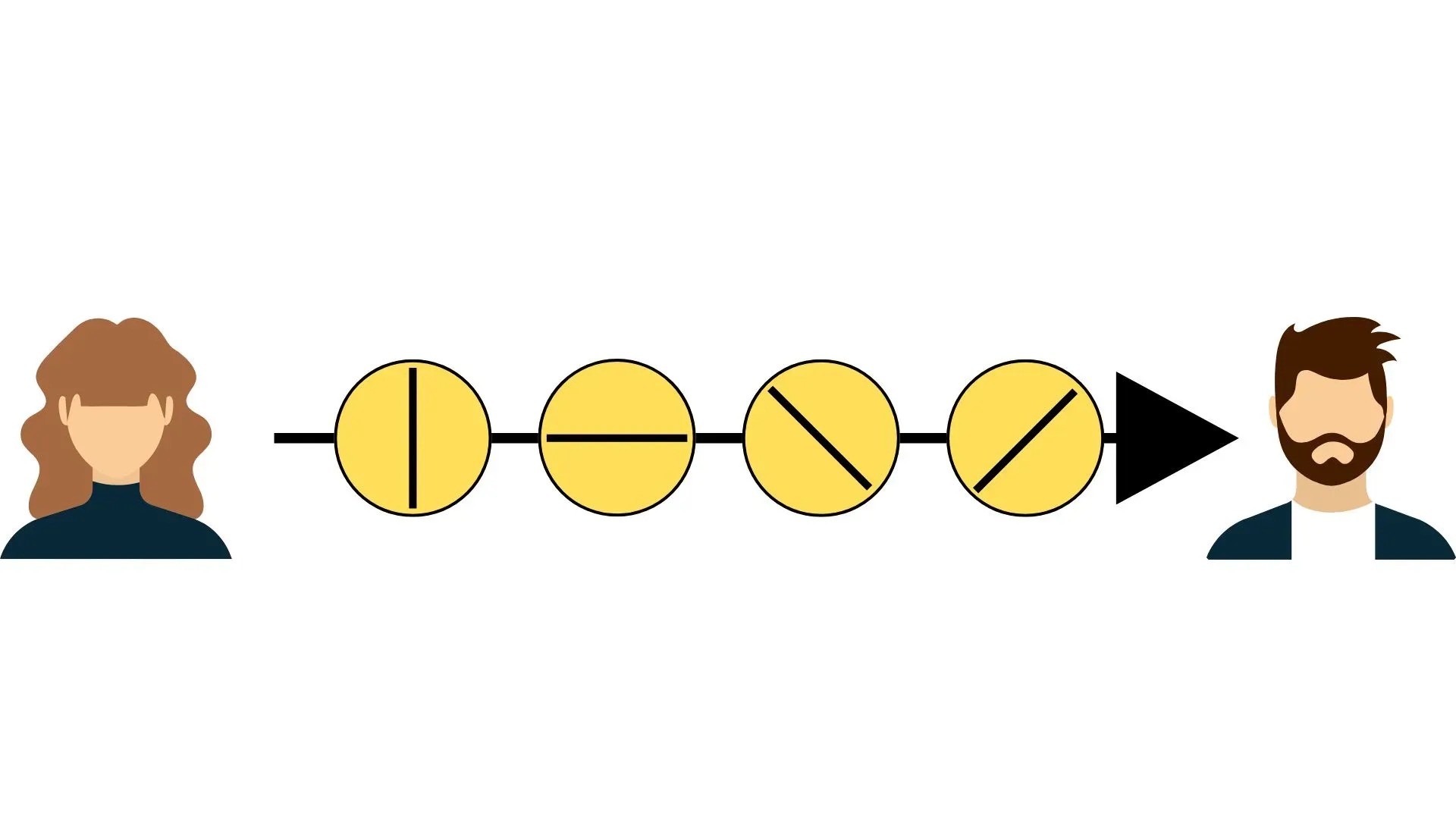
Next, the receiver will measure every photon received by choosing randomly from one of the two bases, straight or diagonal, for each photon. He can't measure the good base so he has 50% chance to guess correctly.
After that, the sender and receiver will look at each photon to see which one was guessed correctly or not. All wrong guesses will be removed and that will be the keys.
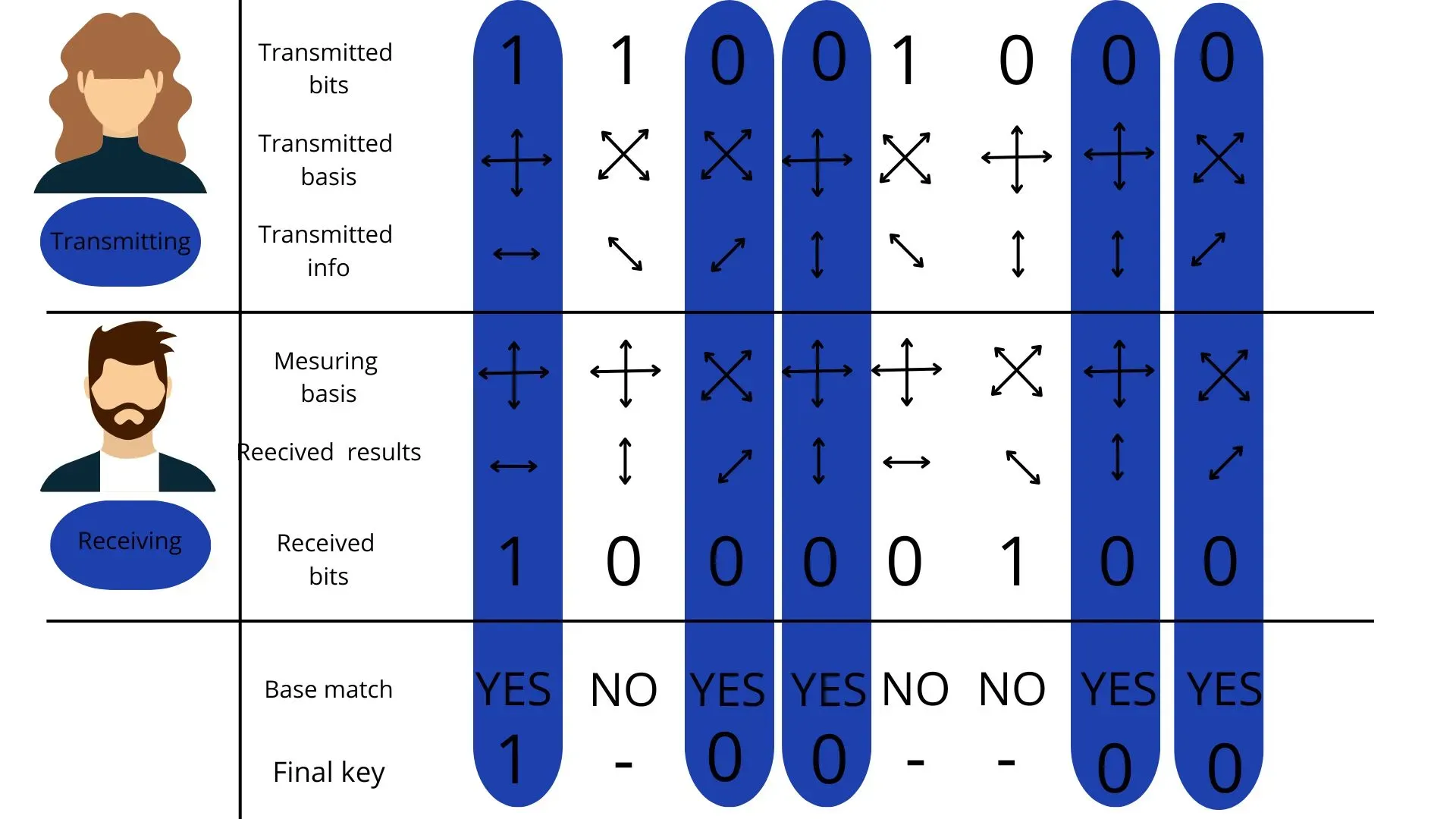
The receiver and the sender will now compare a part of their key to detect any eavesdropping. If someone tries to see the key, he will introduce errors because we can't look because of the uncertainty principle.
Finally, we will use the key with the text that we want to transmit the data that we send.
IV. future
For now, quantum cryptography, despite having been discovered in the 1970s, is nowhere to be used for now for many reasons like basic computers can't use it and we need quantum computers which are really costly, and if we want to use it across the internet we will need to replace most of the internet infrastructure. And to finish, the hardware is really limiting. We are forced to use optic fiber to send photons (there is a project like Micius but it will certainly never be available for civilian or enterprise).